What Does 12 Hours on Set Look Like in Windsor, Ontario?
A few months earlier, we had introduced the company and its unusual summer experiment: four productions, made back-to-back, with a crew of roughly 70 to 80 emerging filmmakers and recent graduates. The idea sounded ambitious when we first spoke with the team.
By: Taylor Fox
October 7, 2026
Articles
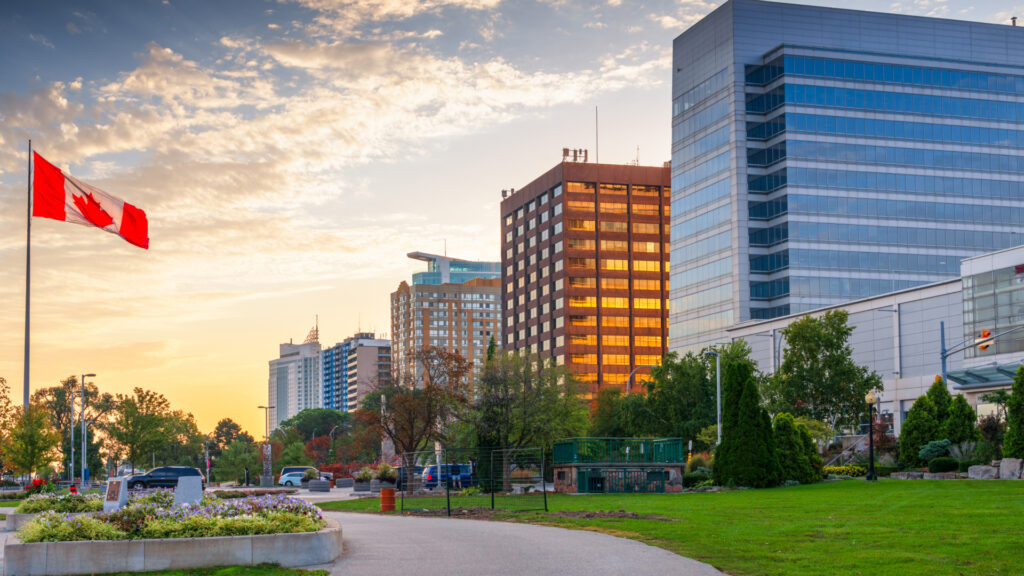
By 8 a.m. on a summer morning, the school was already surrounded by production trucks.
This fall, more than 1,000 students would eventually pass through its doors. On this particular morning, with the school year still weeks away, the only people coming and going were members of a film crew.
I had come to Windsor to see how Buzzflix was doing.
A few months earlier, we had introduced the company and its unusual summer experiment: four productions, made back-to-back, with a crew of roughly 70 to 80 emerging filmmakers and recent graduates. The idea sounded ambitious when we first spoke with the team. Now, after spending much of the summer in Windsor, I wanted to see what that ambition looked like once the cameras were actually rolling.
The answer became apparent almost immediately.
At around 8:10 a.m., I walked into the school and joined the crew’s morning kickoff meeting. The building looked like a high school lifted from a television show, with four floors, long corridors and enough familiar architectural details to evoke any number of fictional American high schools.
The production had taken over all of it.
There was a rhythm to the room that I recognized from professional sets, although I hadn’t expected to find it here. People were already moving with purpose. Departments were checking in. The day’s work was being laid out.
Around 8:30, production got underway.
I found myself thinking about the first production I worked on after graduating, nearly two decades ago. There was plenty of enthusiasm, but there was also the inevitable uncertainty that comes with being new: figuring out where to stand, where to go, who to ask and what was supposed to happen next. There was little of that hesitation here.
Whether it came from spending months together, working through three productions before this one, or simply knowing their jobs, the crew had settled into a routine.
It felt like a film set. The only difference was the address.

A production inside a production
As the morning continued, the school revealed another layer of what Buzzflix had built.
While one group was shooting, another was already preparing for the next production. Around noon, I sat in on a table read.
The people around the table were department leads, including people working in casting, camera and production design. They were also, in many cases, doing completely different jobs on the production currently being filmed.
That detail gets to the heart of what makes Buzzflix unusual.
Bill Marks and Anthony Polito, the producers behind the initiative, had managed to put four productions into the same summer schedule. The participants weren’t being assigned one title and left there for four months. Their roles could change from production to production.
For someone entering the industry, that can mean a remarkably quick accumulation of experience.
One participant started in locations, moved into social media work, then took an opportunity to act before moving into art direction on another production. He described the choice as a question of whether to specialize in one area or “branch out and do multiple different things.”
Another participant arrived without even knowing what role they would have. They could have ended up as a PA, in grip or somewhere else. After working in locations on the first production, they eventually auditioned for the second and landed the role of the film’s main antagonist. The roles were moving around almost as quickly as the productions.
The experiment could have gone very differently
There was a reasonable concern going into the summer that all of this might be too much. Four productions. Seventy to 80 crew members. A city that isn’t traditionally known as a production centre. People working long days, then switching responsibilities for the next film.
Several participants had never worked on a feature before.
One of them acknowledged that the pace and scale could have made the whole thing risky. Instead, when asked whether it felt more like a student production or a professional one, the answer was straightforward: “it feels very professional.”
That distinction came up more than once.
Another participant described Buzzflix as a large production with “actual money” and “actual stakes,” a very different proposition from the student films they had worked on previously.
The production also had to deal with the kinds of problems that don’t care how carefully a schedule has been planned. One actor experienced a death in the family during the summer. The crew adjusted, found a way through it and continued without a serious production hold. A broken air conditioner was apparently one of the more memorable technical headaches.
The response to those problems may have been as revealing as the problems themselves.
By this point, the crew knew one another. They knew the rhythm of the work. They had already made mistakes and had another production coming up on which they could try something different.
One director explained that working on the first three films gave her the opportunity to see what worked, identify mistakes and make sure she didn’t repeat them on the fourth.
Four productions created something that one production rarely can: the chance to learn from one movie and immediately put that lesson to work on the next.
A director, months out of school
The most striking example was sitting somewhere inside the same building.
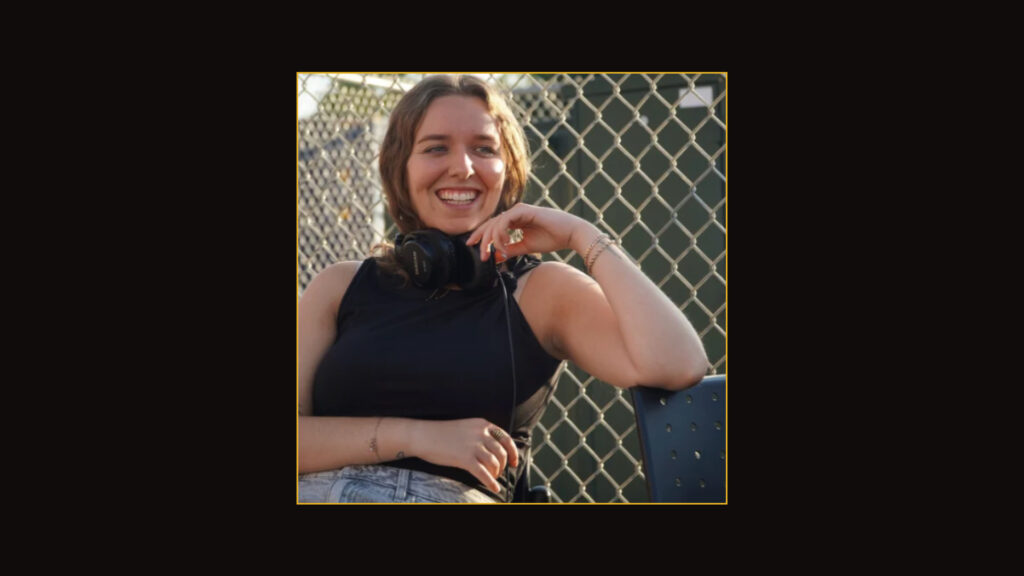
One of the participants had graduated from Humber only a few months earlier. She was now writing and directing a feature.
She had been told in film school that writing and directing a first feature immediately after graduation wasn’t how the industry worked.
Then Buzzflix gave her the opportunity to do exactly that.
“I graduated back in June, and I’m writing and directing a feature film,” she said.
The responsibility was considerable. She described the pressure of directing the fourth production, particularly because the film represented a chance to demonstrate that the mentorship model was working and that the participants were getting better as the summer progressed.
She also had three previous productions to draw from.
That meant she wasn’t walking onto a set cold.
She had watched other people make decisions. She had seen things go wrong. She had worked with the crew who would now be looking to her for direction.
That changes the experience.
Learning the set from the other side
The same thing was happening throughout the production.
A person who had spent one film in locations could suddenly be sitting in an art department meeting. Someone who had been working behind the scenes could find themselves in front of the camera.
For actors, that perspective is particularly interesting.
The participant who eventually played the antagonist had not joined Buzzflix expecting to act. He had done musicals in high school and had always enjoyed performing, but didn’t realize it would be an option on the production. When the opportunity came up, he pursued it.
The experience also gave him a different understanding of what happens around an actor.
He went from working as a crew member to having makeup, transportation and a different set of responsibilities once he was cast. Later, he moved into art direction and found himself giving instructions to people he had previously worked alongside.
The movement between those roles seemed to have one unexpected benefit: people became more aware of what everyone else was doing. The usual boundaries between departments were a little less rigid.
Someone who had spent the morning on one side of the production could spend the afternoon seeing it from another.
Twelve hours a day, five days a week
There was also the less glamorous part of the summer.
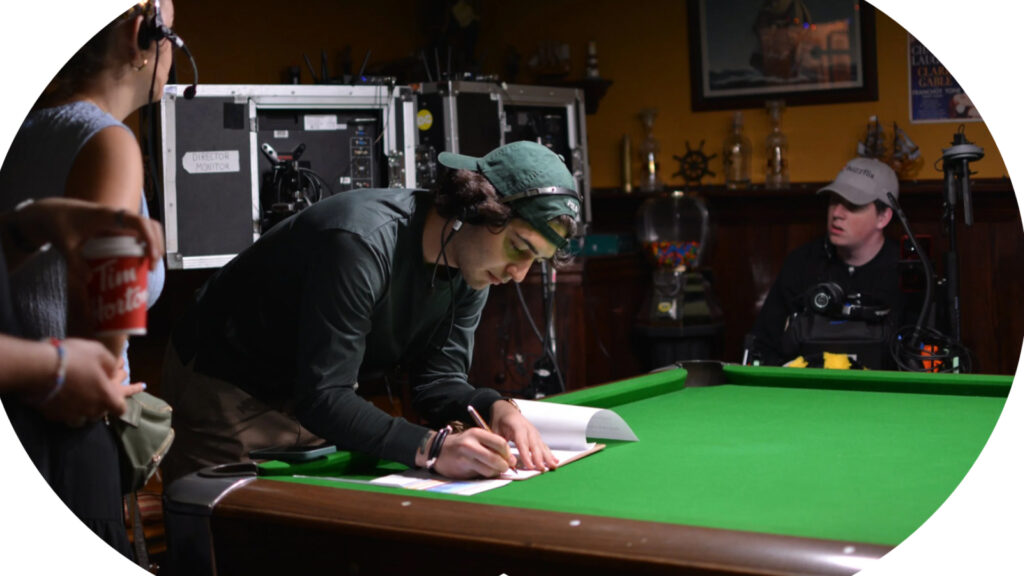
The crew was working roughly 12-hour days, five days a week, for months at a time.
Living and working in Windsor meant that the people on set became one another’s social circle, too. They were together during the week, then often saw one another again on weekends.
One participant laughed about the fact that they were essentially the only people in Windsor who understood what it was like to spend 12 hours a day, five days a week on a film set.
That shared experience also created something that can be difficult to manufacture on a production: a network.
The participants came from different schools and film programs, expanding their circles well beyond the classmates they had known before the summer began. They also developed relationships with the mentors working alongside them.
When asked what they hoped to take away from the experience, networking came up quickly.
One participant pointed to the possibility that, months or years later, someone from Buzzflix might be looking for a crew member and remember someone they had worked with that summer. Another explained that a previous relationship with one of Marks’ other companies had already helped lead to writing and directing opportunities.
“That’s all this industry is,” the participant said. “It’s networking.”
By the time I left the school, that part of the experiment seemed just as important as the productions themselves.
The crew had spent an entire summer learning each other’s strengths, watching each other work and figuring out who could be trusted with what.
The school will be a school again
Eventually, the production day moves on.
People start packing equipment. Departments prepare for the next call. The school will eventually return to its regular life, with students filling the hallways and the production trucks gone.
For the crew, though, the summer will follow them.
Some will leave with a directing credit. Others will have worked in locations, production, camera, art, makeup or acting. Some will have done several of those things.
One participant was even hired by Buzzflix to continue working with the company after the summer, helping develop films for the following year.
That may be the clearest indication of what the four-production experiment became.
The original question was whether a group of emerging filmmakers could be brought together, given professional responsibilities and expected to make four productions in a single summer.
After watching them work, the more interesting question may be what happens to those filmmakers after they’ve spent four months doing it.
For one morning in Windsor, at least, the answer was easy to see.
At 8 a.m., there were production trucks outside a high school.
By 8:30, everyone was working.
At noon, one production was being filmed while another was being read around a table.
The people in that room had different titles for the day, and in some cases, different titles waiting for them on the next film.
Then the work continued.
Twelve hours on set, in Windsor, Ontario.


